AZIZ MURAT ASLAN
BACKSTORY
A 14th-century rascal (Karagöz) introduced me to a 21st-century hayali (Aziz).
The date was October 21, 2020. Along with my friend (and AWB co-founder) Athena ‘Tina’ Longoria visiting from New York City, I attended Karagözüm Iki Gözüm (Karagöz My Dear), an exhibition at Istanbul’s prestigious Yapi Kredi Culture & Art Center. One of the artists referenced was Istanbul resident Aziz Murat Aslan. It didn’t take me long to track Aziz down. And so began our many artistic collaborations, including exhibitions and Karagöz performances in my home.
RE-INTERPRETING CULTURAL HERITAGE
WLM=Walter L Meyer
AMA=Aziz Murat Aslan
WLM Aziz, you’ve got an advanced engineering degree. But I know you as a serious devotee of Turkish Karagöz shadow puppet theater, a UNESCO Intangible Cultural Heritage. How did that happen?
AMA Well, after years of working as an engineer, and lecturing at universities, I realized engineering just wasn’t my passion. So in my mid-thirties, I took a leap into the world of art and creativity. It was a bit risky. But it was probably the most important decision of my life.
WLM How did you learn about Karagöz, and make this major life transition?
AMA At the time I was living in Germany where I’d gotten my engineering degree. I visited museums there, and saw several collections of Karagöz puppets. I also researched books by Orientalists and other scholars.
WLM But you ultimately started making Karagöz figures—tasvir.
AMA Yes, when I returned to Turkey, I met with several Karagöz artists. They taught me how to carve puppets from leather—usually camel leather—using traditional techniques. I also researched historical performance practice. With time, my engagement with Karagöz spanned multiple inter-related roles: tasvir (puppet maker), hali (performer), and even playwright, and one who wants to re-interpret the traditional Karagöz play canon.
WLM And that led to your writing your first original play—Seven Deadly Sins—which I’m proud to say had its debut in my home.
AMA My goal has always been to treat Karagöz shadow theater as a living, evolving art form. Not a fixed tradition. After I became comfortable and knowledgeable about the traditional Karagöz play structure, I had the courage to write my own play. I wanted to move the needle a little, so to speak.
WLM What do you mean by that, Aziz?
AMA Seven Deadly Sins is similar to the traditional canon in some ways. For example, it uses stock characters and rhythmic dialogue. But it’s different in that it leans toward a more philosophical and cyclical narrative. This intersection of traditional and contemporary theatrical forms results in Seven Deadly Sins being a more layered metaphor. Rather than presenting a simplistic binary of good versus evil, the play explores a more complex morality.
WLM Let’s focus now on the subject of the painting in my collection: Muhteris (Greed).
AMA In writing Seven Deadly Sins, I decided that all of the sins should be based on classical Karagöz demons. Muhteris is based on the female demon Canan.
WLM I find it fascinating that you were able to transform Greed from a three-dimensional leather figure used in your play to a one-dimensional painting.
AMA As a painter, the challenge was translating shadow aesthetics into contemporary painting. I wanted to remain loyal somehow to the traditional technique used to create the puppet figures. Of course, I couldn’t use the same knives I use to carve the leather figures, but I did use paper-cutting knives.
WLM The figure of Muhteris—Greed—is pretty grotesque looking. Can you explain her frightening body?
AMA Muhteris represents the sin of Greed as a distortion of desire. Muhteris’ entire body is covered with different faces, different souls. The two snakes she holds represent the duality of greed: acquisition and control (or lack thereof). The monster wrapped around her waist is the embodiment of possessiveness. What is owned, constrains. And the creatures on her kneecaps symbolize her body being taken over by the desire to own even more. Greed’s body is a site of over-accumulation.
WLM You used a lot of gold in this painting. I’m sure that has symbolic meaning.
AMA Gold is an imperial aesthetic. Gold also reflects greed’s paradox. What shines also eventually corrupts. Perhaps from an ironic point of view, it also refers to illumination. Sacred iconography. Normally, I can’t use gold when I make leather figures because it isn’t transparent. So I enjoyed being able to use it here.
WLM I understand, Aziz, that you’re planning to adapt Seven Deadly Sins into an opera. That’s going to be amazing. I’d be thrilled to host that debut!
AMA Thank you, Walter! I’ll keep you apprised of its progress.
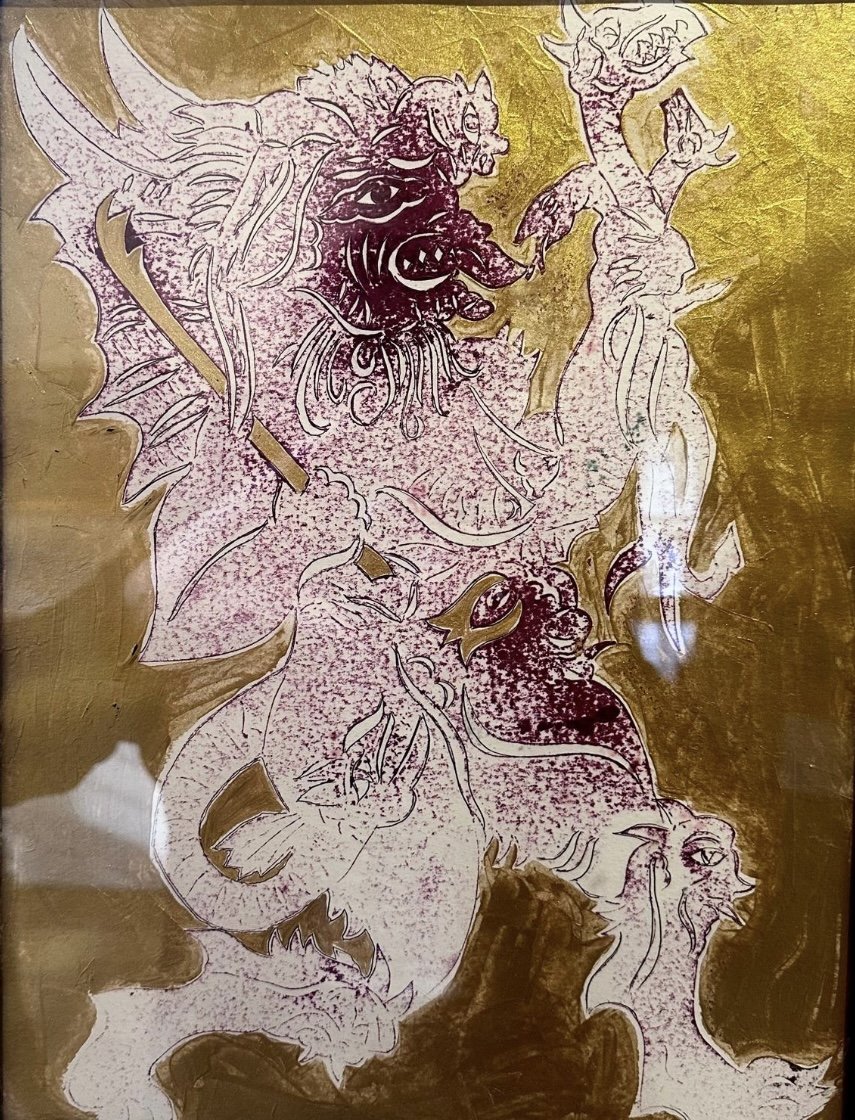
MUHTERI (GREED)
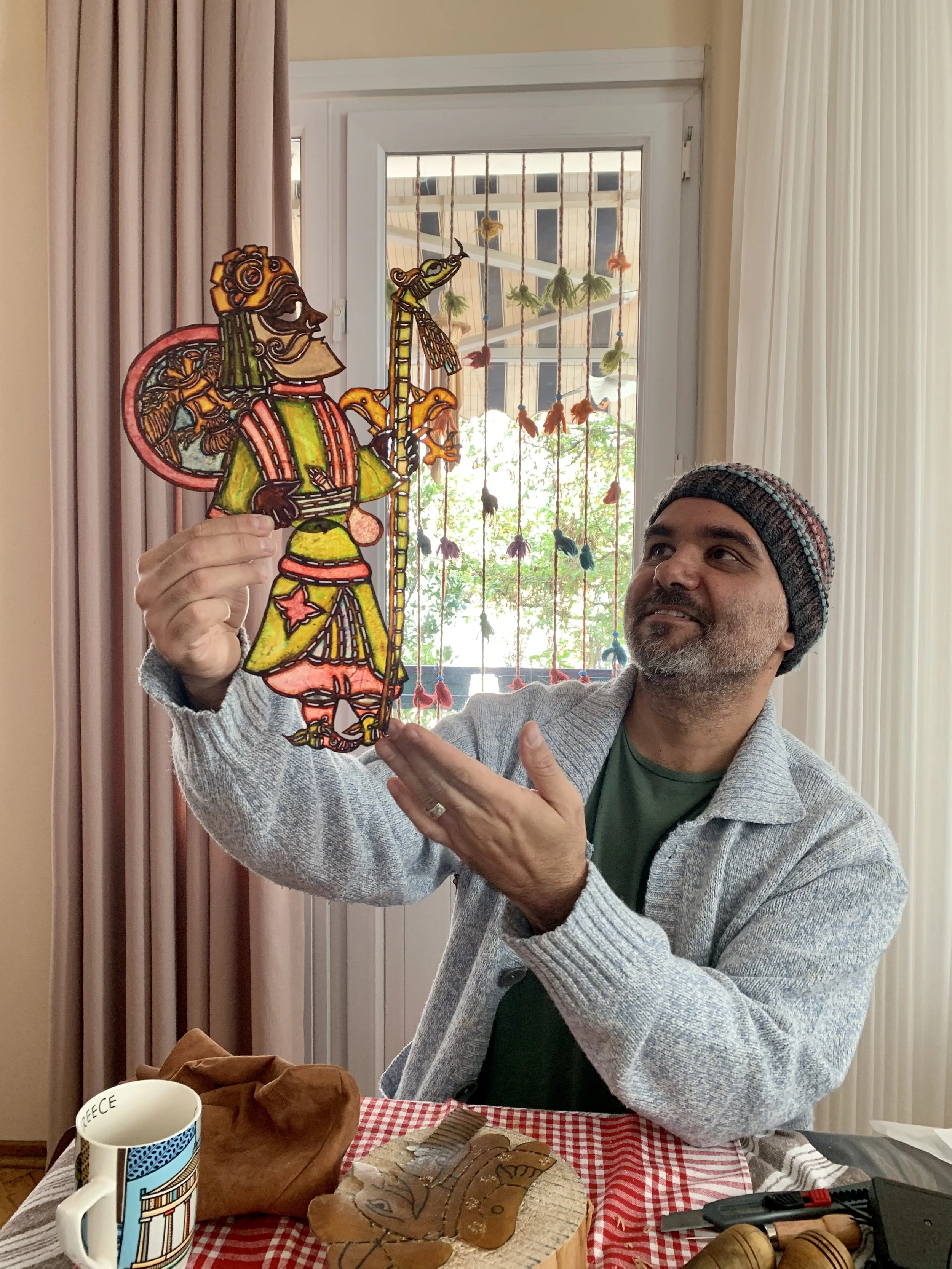
Aziz Murat Aslan, Istanbul, Turkey
My goal has always been to treat Karagöz as a living, evolving art form
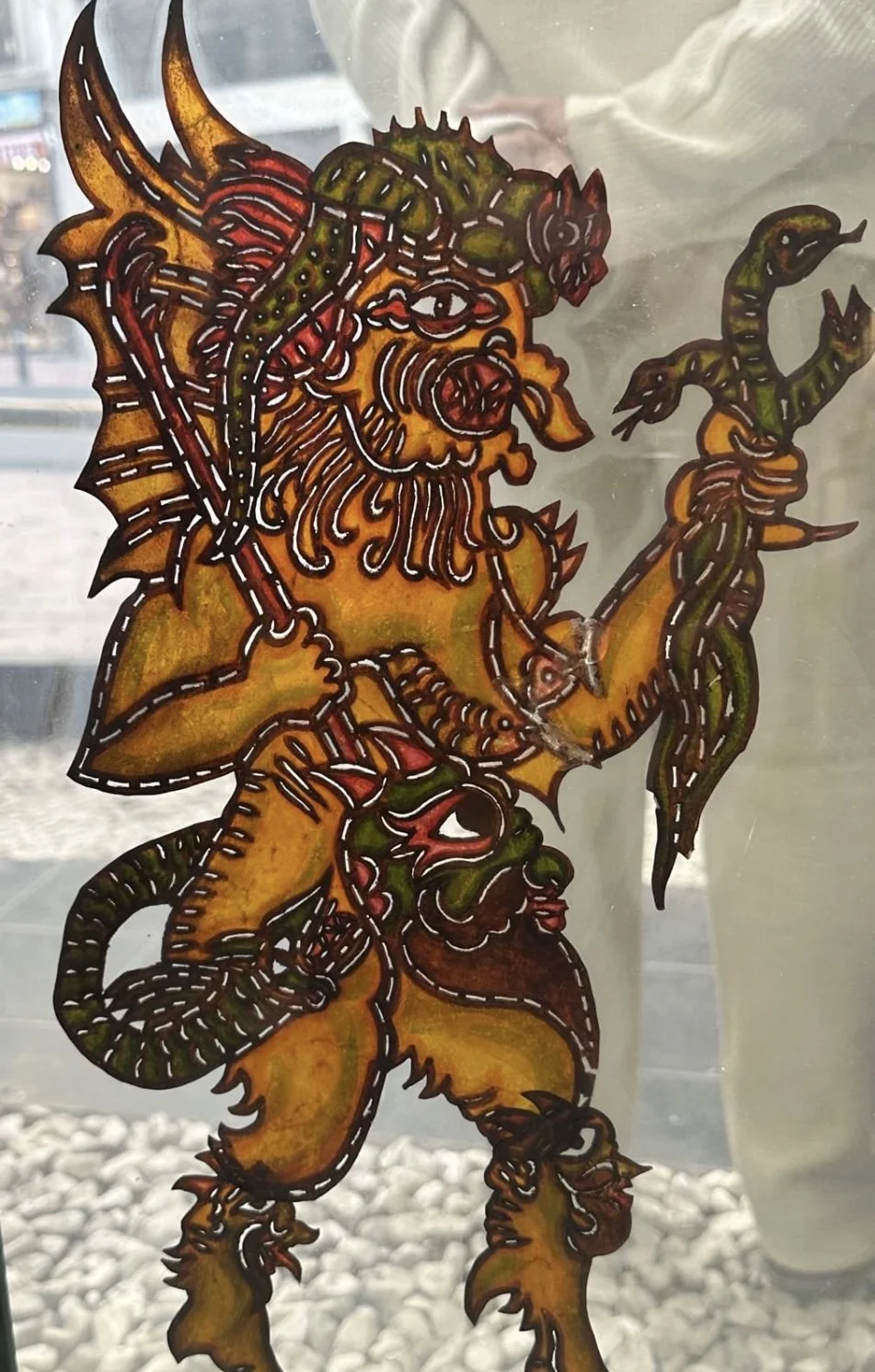
Muhteris as a tasvir (puppet), Seven Deadly Sins
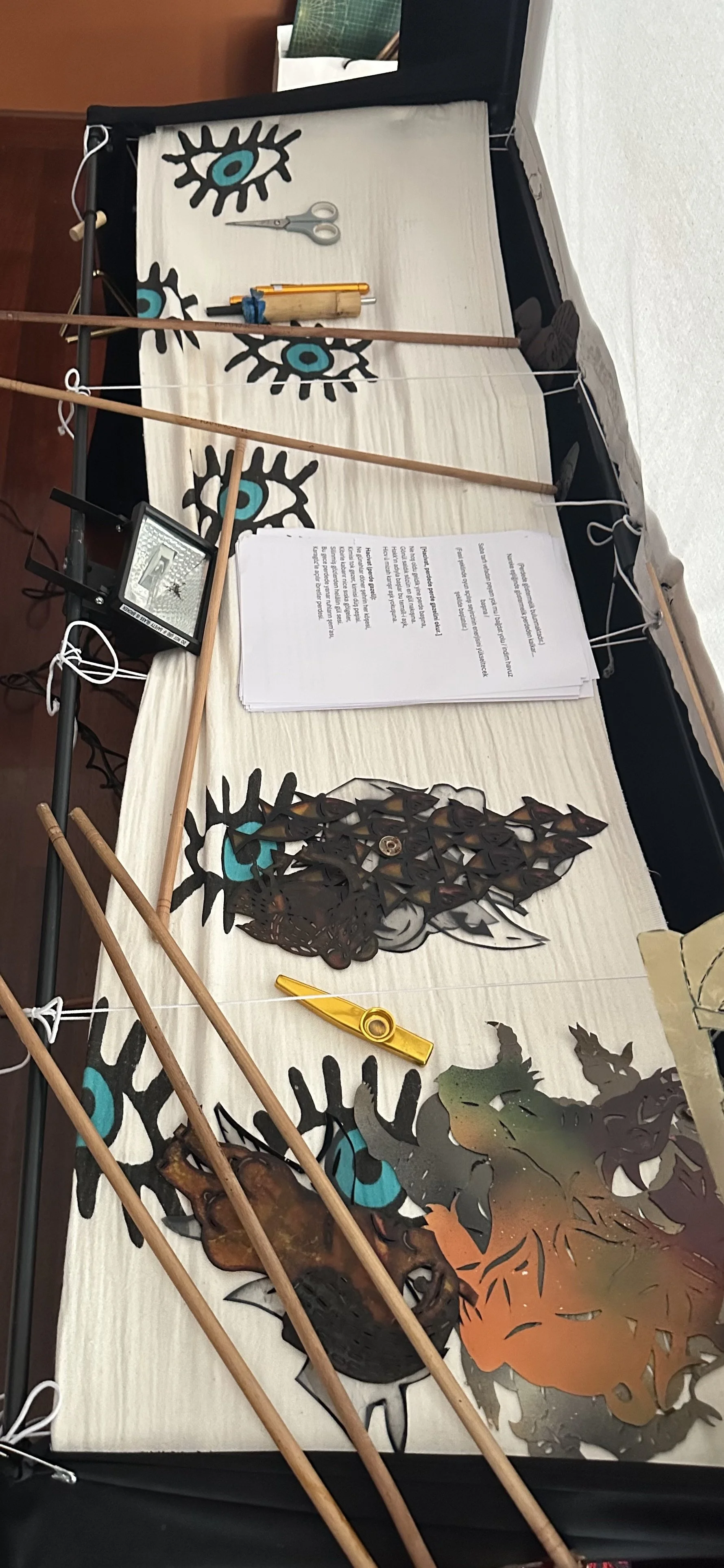
Behind the scenes, Seven Deadly Sins
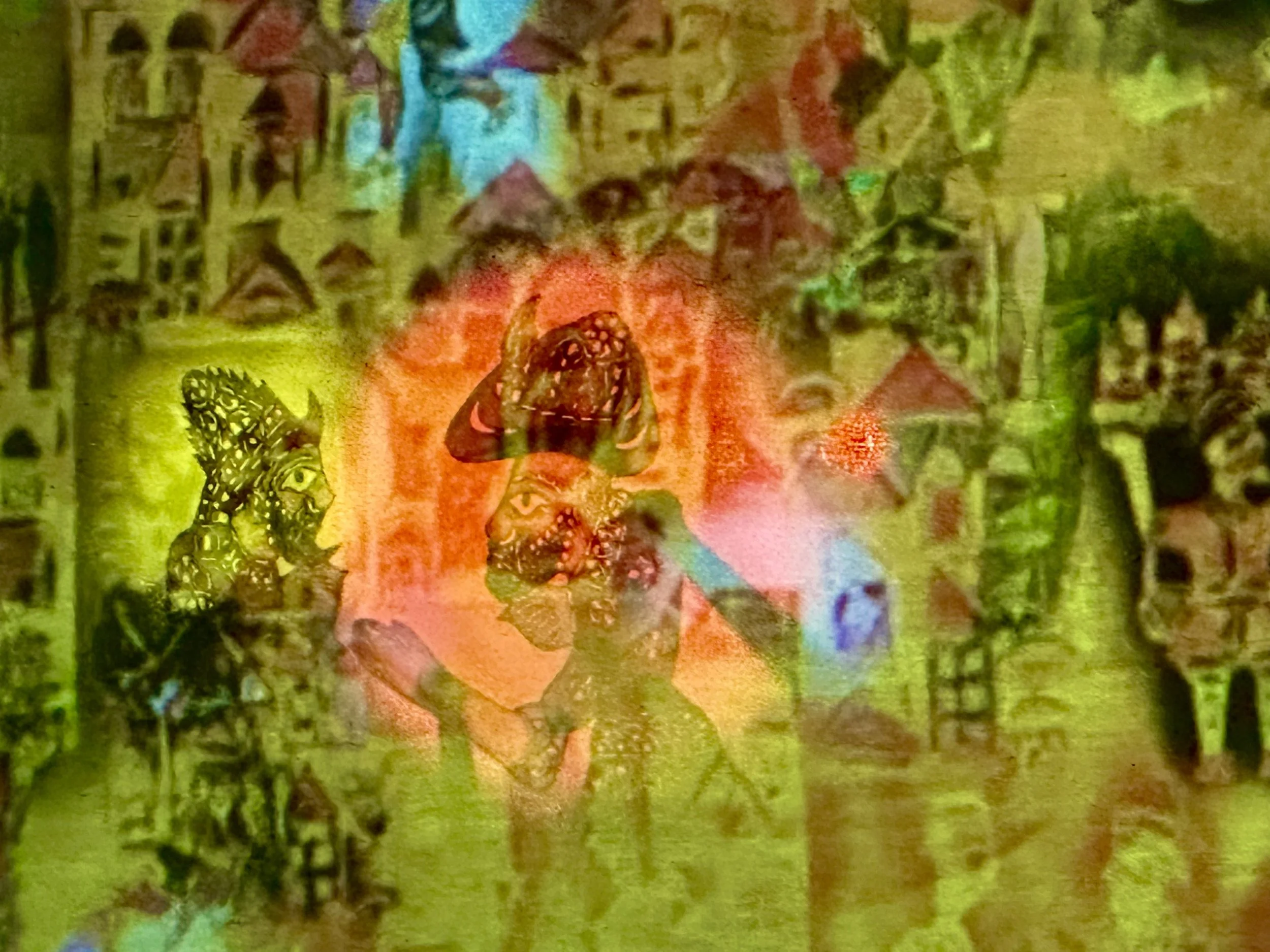
Karagöz and Hacivat behind the screen, Seven Deadly Sins