FROM CAVE TO CANVAS
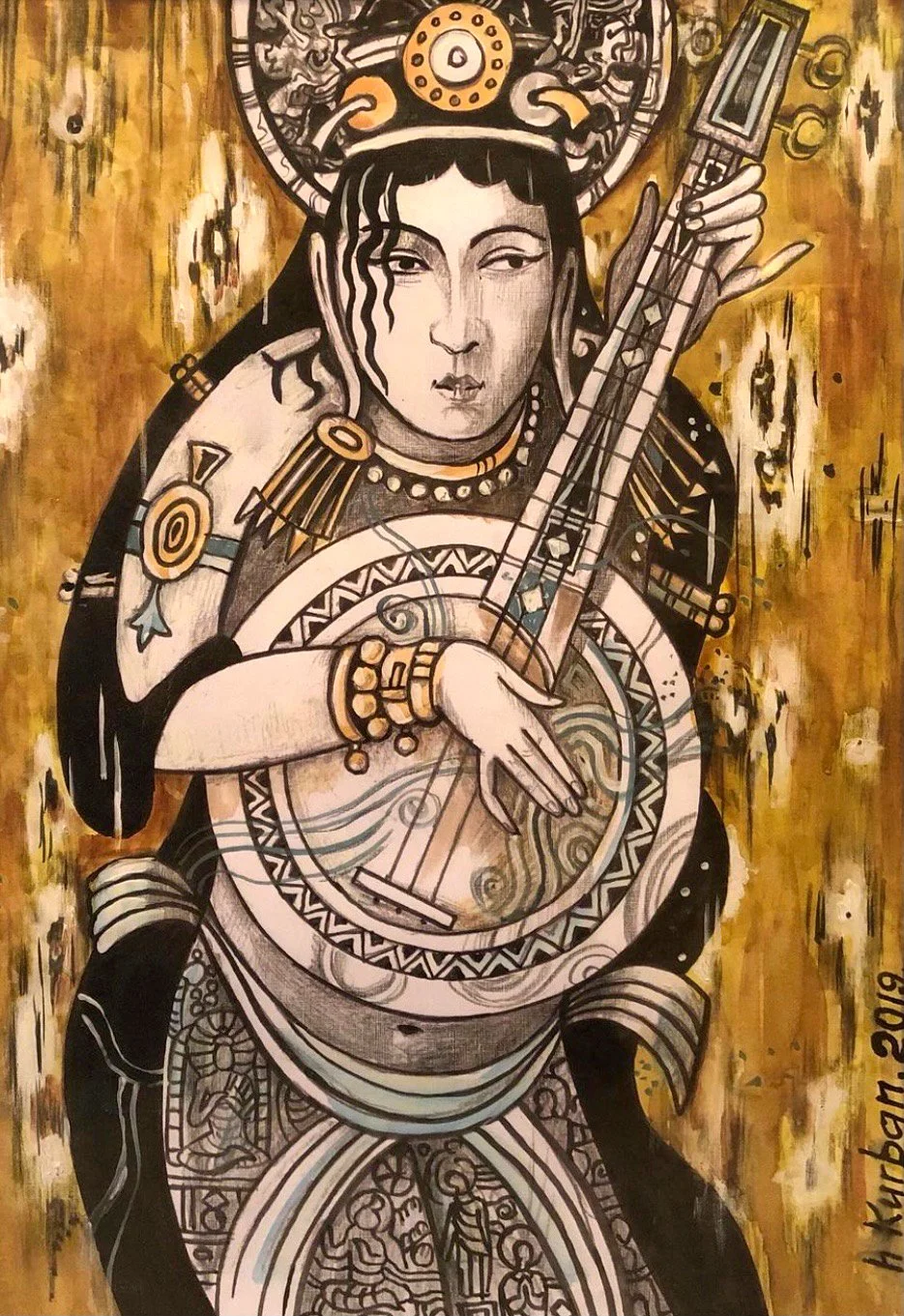
Melody of Turfan
Hashim Kurban (Uyghur/Kazakh)
What intrigued me about Hashim Kurban’s paintings when I first saw them on Instagram was their documentary nature. They seemed to be recording a culture in the process of disappearing. In addition to the feeling of nostalgia, there was also something very personal about them.
It turns out Hashim’s artwork is an homage to his people—the Uyghur— and to his family. A Turkic-speaking people originating in Central Asia, the Uyghur have lived for more than a thousand years in Silk Road oasis towns in what is today northwest China. Though Hashim lives in Kazakhstan, he traces his Uyghur roots through both of his great-grandfathers to the oasis towns of Kashgar and Khotan.
Hanging on the wall in my bedroom, Melody of Turfan reflects the Uyghur’s complex history. Before converting to Islam in the 10th century, they were Buddhists, Nestorian Christians, and Manicheans.
Hashim explains his unusual path to creating this piece…
Fascinated by the countless stories my parents told me as a child, I began painting the history of our people from my imagination. When I visited the sacred Bezeklik Thousand Buddha Caves—a complex near Turfan dating back 1,500 years—I was awestruck. But it was strictly forbidden to take photographs or even sketch the murals while I was in the caves. So I kept the memories in my mind and in my heart. Here a princess plays an ancient Buddhist instrument, a scene inspired by those awesome murals.
Various human rights organizations now accuse the Chinese government of subjecting the Uyghurs to crimes against humanity and genocide, and detaining more than one million in ‘re-education camps.’
To see more of Hashim’s artwork, visit Silk Road Memories exhibition.