
DECODING A PORTRAIT
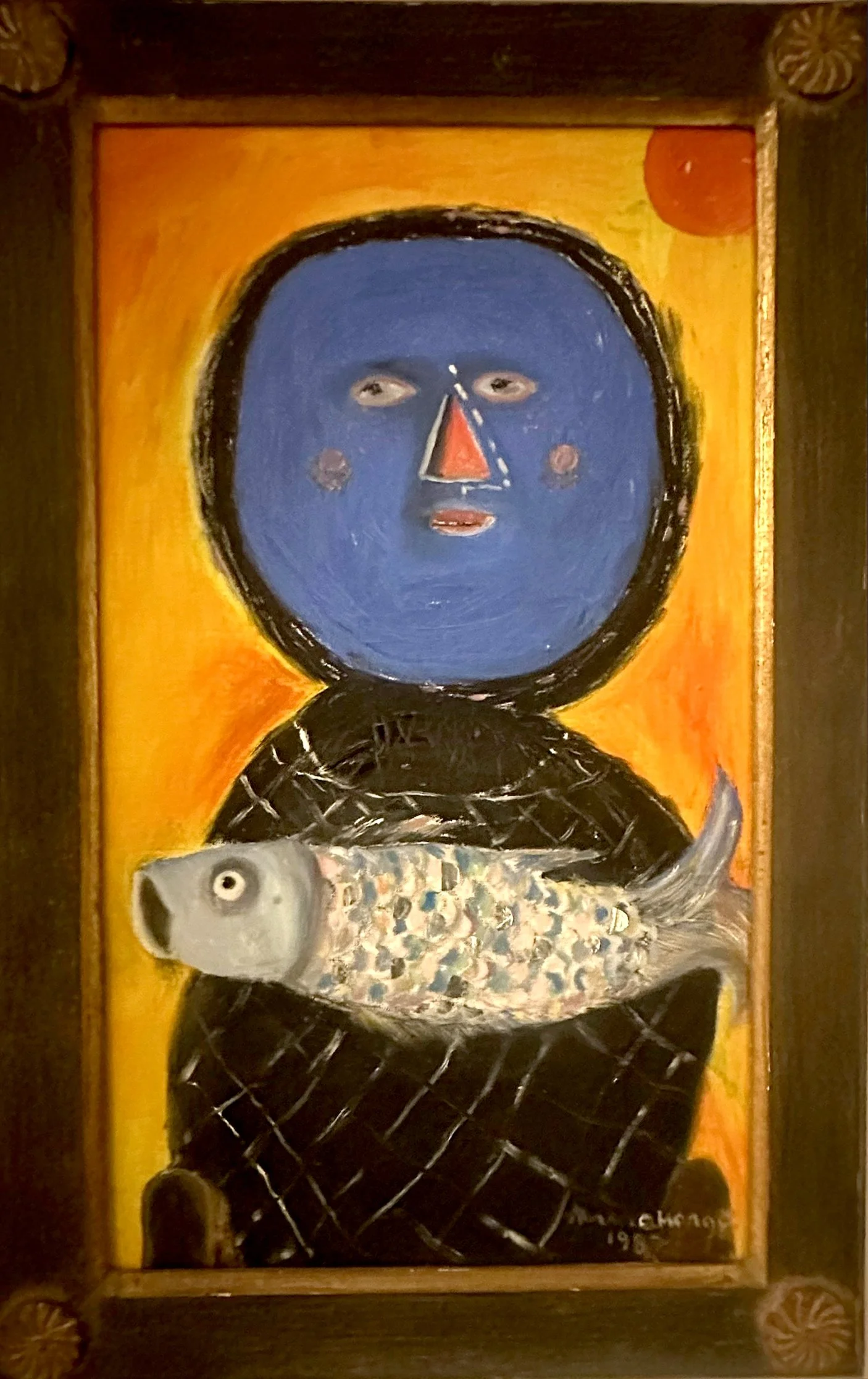
Fisherman
Margit Anna (Hungarian)
Wanting a reprieve from urban Budapest, I embarked on a short trip to the ‘artist colony’ of Szentendre. Little did I suspect that its picturesque baroque-style houses and warm Mediterranean atmosphere would lead me to Anna Margit—an artist whose paintings were informed by the horrors of the Holocaust, the devastation of World War II, and Hungary’s subsequent Communist era.
This unsettling, yet appealing, painting looked like nothing I’d ever seen. Its luminous, sunny background seemed utterly incongruous against the inscrutable figure—whose eyes seemed to stare directly at me as if through holes in the canvas. And there was a fish gasping for air.
At the time, I knew next to nothing about Margit Anna except that she and her husband Imre Ámos (the ‘Hungarian Chagall’) were Jewish. While Anna hid and escaped Auschwitz, Amos perished in a Polish concentration camp.
Many years later, I learned that Fisherman is this painting’s title, and that it had appeared on the cover of a catalogue produced by Szentendre-based Gallery Erdész. Naturally, I wrote to them, and owner László Erdész quickly replied…
Fish hold a symbolic significance to the Jewish people because the depth at which fish swim protects them from harm. The fisherman of the title is simply Jesus.
Given the many tragedies of Anna’s life, the safety symbolism of the fish seemed very reasonable (and further research confirmed this). But László’s interpretation of the painting’s title as a reference to Jesus initially struck me as somewhat dubious.
Additional research, however, revealed that much of Anna’s work was self-portraiture, and frequently involved role-playing. So was she presenting herself here as Jesus—who like her—was a Jew?
I also learned that towards the end of her life Anna returned to the surrealistic ‘European School’ style she had famously established following WWII—characterized by a somber, genderless large-headed figure outlined in black and surrounded by bold colors.
This painting seems to perfectly reflect Anna’s return to that earlier style. (It was painted in 1987; Anna died in 1991.)
Research has its rewards. It also raises questions.