
WOMEN’S ART NO MORE
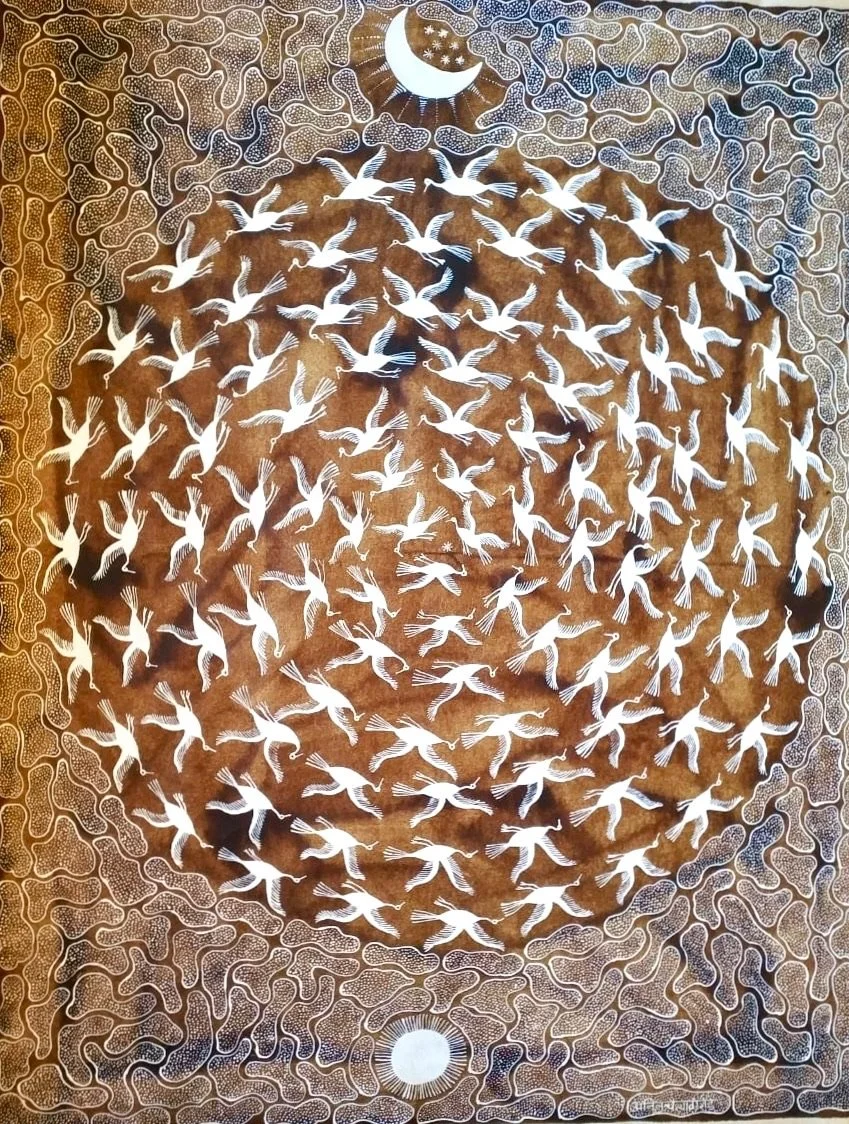
Asara
Anil Chaitya Vangad (Warli/Indian)
I was introduced to the tribal art of India in a rather unlikely place—The Beatrice Wood Center for the Arts in Ojai, California, where I’d gone to see the work of one of the 20th century’s most important and eccentric American potters (Beatrice Wood).
However, one of its side galleries featured a very unusual exhibition of tribal art from India that took my breath away. The Center kindly shared the organizer’s email address with me: Padmaja Srivastava, an international supporter of her country’s tribal artists.
Thus began a long-distance correspondence course with Padmaja focusing on the fascinating art of the adavasi—the people believed to be the subcontinent’s original inhabitants. Unbeknownst to me, India has one of the largest and most diverse tribal populations in the world. Like indigenous people globally, they tend to face civil and land rights challenges.
I became particularly interested in the work of Anil Chaitya Vangad, a member of India’s large Warli tribe. Spanning more than 1,200 years, Warli traditional art was originally the domain of women who painted ritualistic designs on their mud huts. According to Padmaja, this all changed in the 1970s when Jivya Mashe (a man) started painting images on portable—and therefore saleable—paper and cloth. An unpaid spiritual practice became a source of income.
Despite this gender sea change, Anil learned to paint from his mother. Padmaja personally delivered Anil’s Asara to me when we finally met face-to-face when she visited Istanbul with her family.
Anil shed light on Asara’s meaning in an email facilitated by Padmaja…
We consider nature to be God and worship the seasons, moon, sun, trees, rocks, and animals. ‘Asara’ refers to the flock of birds circling round and round both night and day, indicating the presence of the tiger god. Babies cease to cry. This painting is auspicious.
Anil used traditional Warli materials to create Asara: red clay, cow dung (odorless!), and rice paste. I enjoy seeing the looks on visitors’ faces when I ask them to guess the source of its brown color.