
REFIRING THE PAST
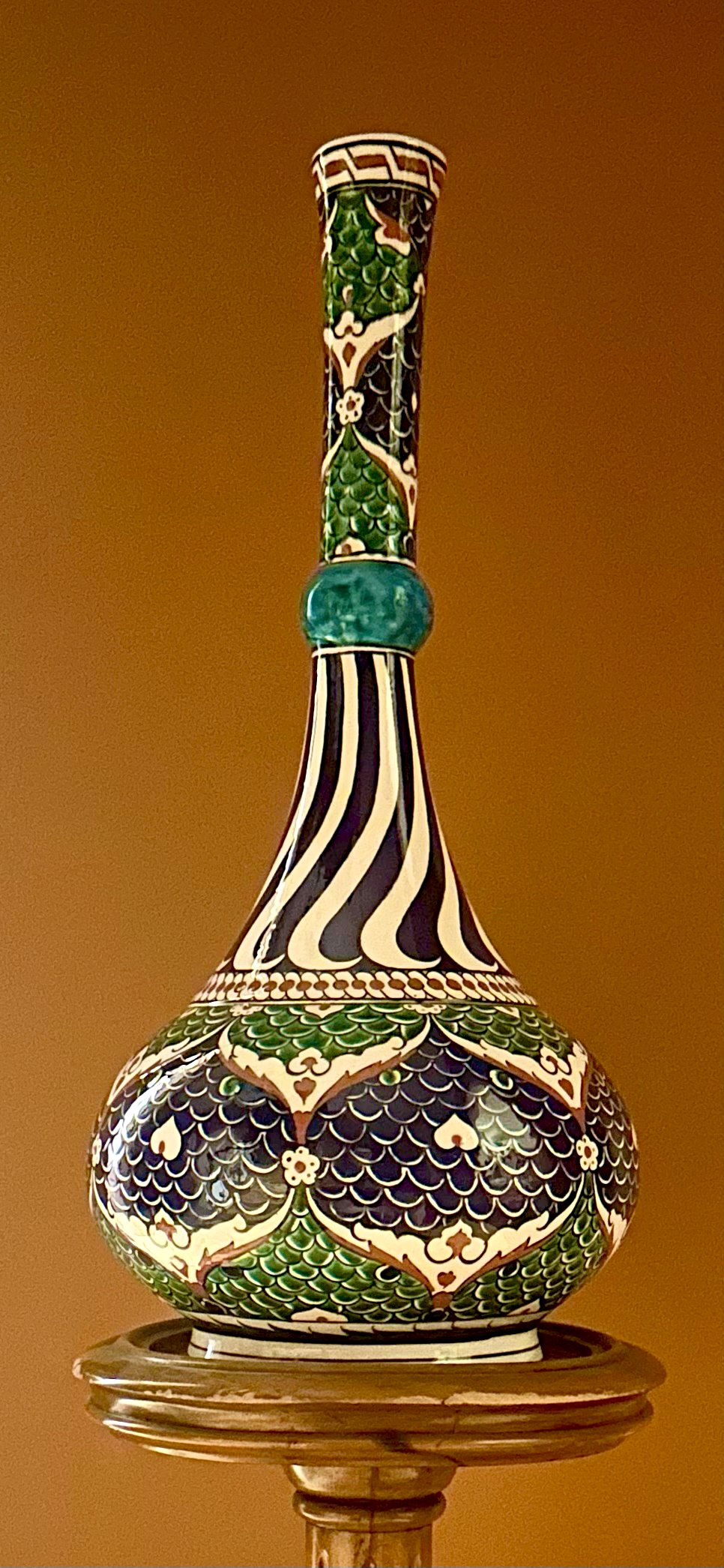
Iznik Sürahi (replica)
İsmail Yiğit (Turkish)
How did this replica of a 16th-century Ottoman sürahi (water bottle) find its way to my home?
It’s a centuries-long story that begins in China, travels through the medieval Islamic world, attains its zenith in the Anatolian town of Iznik, and enjoys a rebirth centuries later thanks to a living Turkish ceramic usta (master): İsmail Yiğit.
Porcelain, invented in China more than a millennium ago, was highly prized in Islamic lands as early as the 7th century for its bright whiteness, translucency, and strength. Then in the 9th century, Islamic potters invented fritware—a unique mixture of clay, ground glass, and quartz that mimicks porcelain’s desired qualities. Towards the end of the 15th century, Iznik—located near the new Ottoman capital of Istanbul—became its production center.
Fast-forward several centuries. In 1989 İsmail usta set a very ambitious goal for himself—the revival of Iznik ceramics. When I asked him why and how, this was his reply…
Iznik pottery is considered the pinnacle of ceramic art. I enjoyed the guidance of renowned artist Erdinç Bakla, and an authoritative book: Iznik, The Pottery of Ottoman Turkey. I began by photographing many of the pieces in that book, which also provided information about where they could be found. My research took me abroad to Athens’ Benaki Museum, and England’s British Museum, Victoria and Albert Museum, and Leighton House.
To date, İsmail has reproduced more than 450 Iznik replicas that are as close as possible to the originals. I bought this piece some 20+ years ago in a sort of a ‘pop-up shop’ in the Istanbul apartment of one of his friends. Today İsmail’s work can be found in several highly respected venues.
Ironically, while Istanbul’s Topkapi Palace Museum possesses over 10,000 pieces of Chinese porcelain, it contains almost no Iznik pottery. Most surviving pieces are in foreign museums.
But you can find this beautiful 16th-century replica in my very own museum.
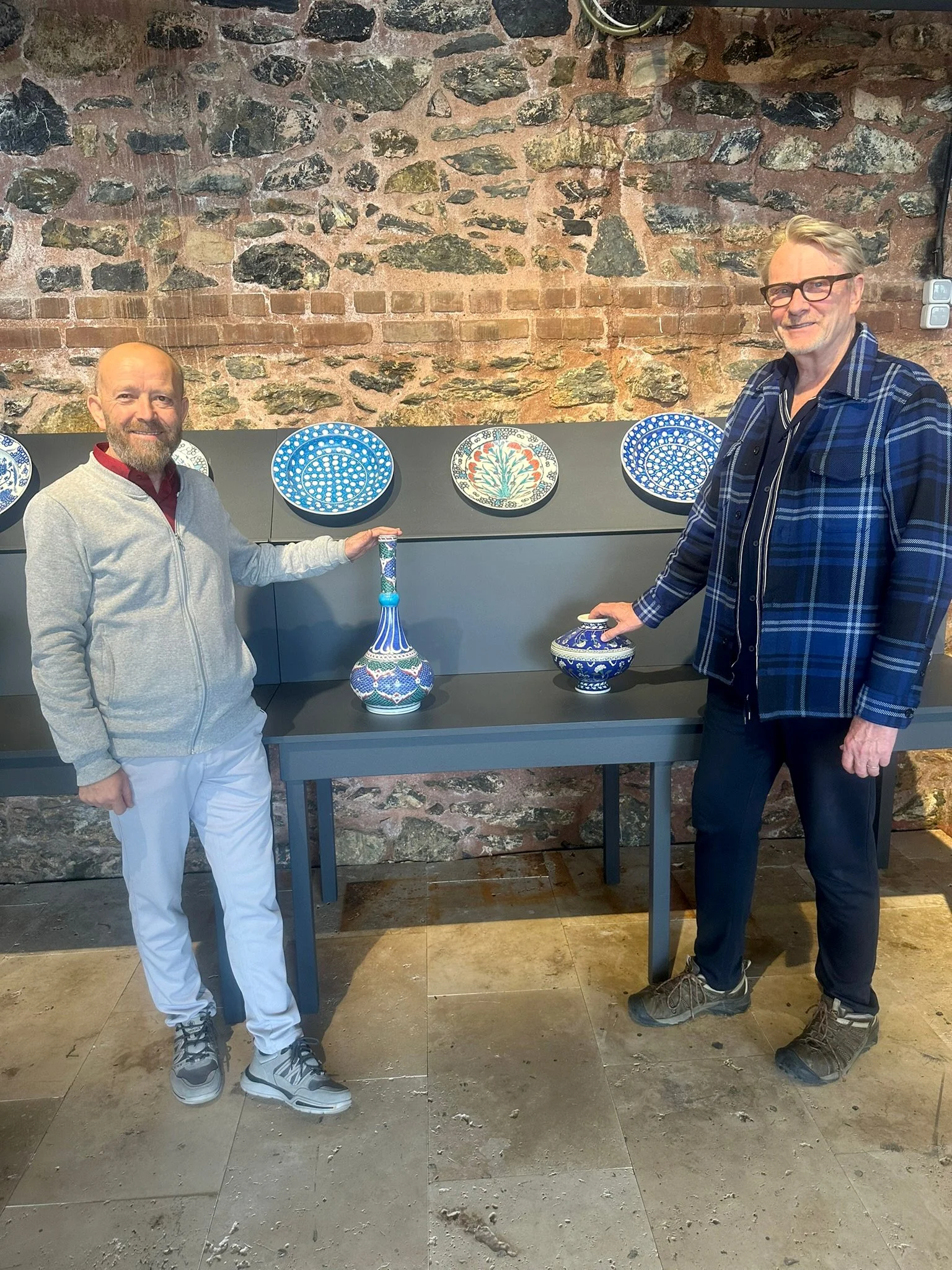
I had the pleasure of meeting İsmail, seen here with an array of his Iznik reproductions, at Istanbul’s Tulip Museum.