1001 ARABIAN NIGHTS: A BRIEF HISTORY
Curator Walter L Meyer
This collection of colorful stories—mostly cautionary tales with a moral—probably became known in the West as 1001 Arabian Nights because the texts the first European translators worked with were written in the Arabic language.
However, these tales have a very long and complex pedigree.
Scholars agree that what has come down to us today is actually a group of popular stories passed down orally for millennia before being compiled as a single written text repeatedly over centuries. The ‘frame story’—a woman telling a series of ‘cliffhanger’ tales in order to prolong her life for another night—is probably Indian in origin. And many stories have Persian roots. However, this wide variety of tales probably also came from Iraq, Egypt, Turkey, Greece and beyond.
Perhaps the biggest surprise is that the stories best known in the West—Aladdin, Ali Baba and the 40 Thieves, Sinbad the Sailor—are latecomers, added to European translations in the relatively recent 18th century.
Finally, don’t take ‘1001’ too literally. It was only meant to convey ‘a lot!’
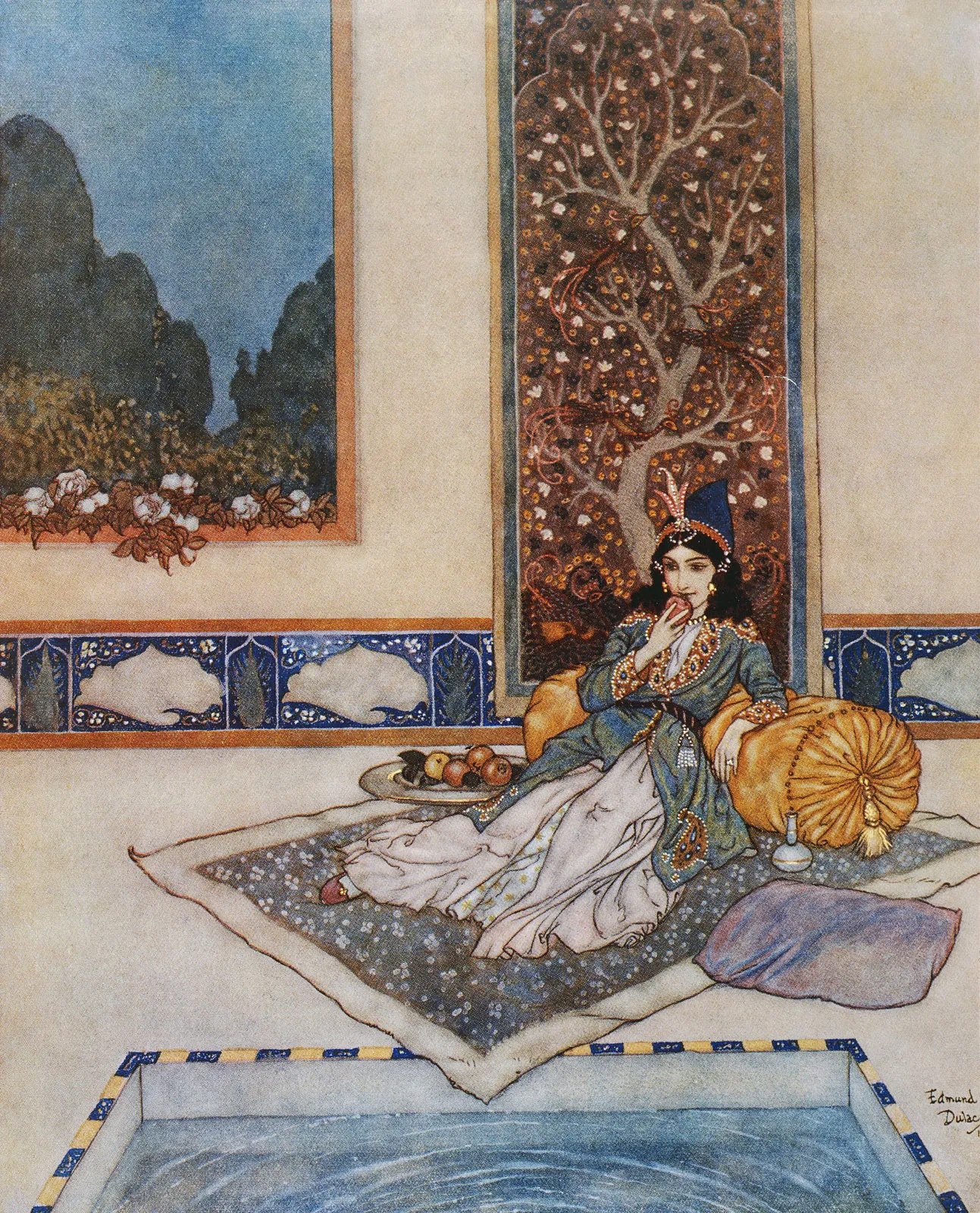
Scheherazade, the legendary 1001 Nights storyteller, as imagined by Edmund Dulac (1882-1953).